


-
Search vehicles
Vehicles by Brand
- Direct Import
- Finance Information
- Locations
- Nationwide Delivery
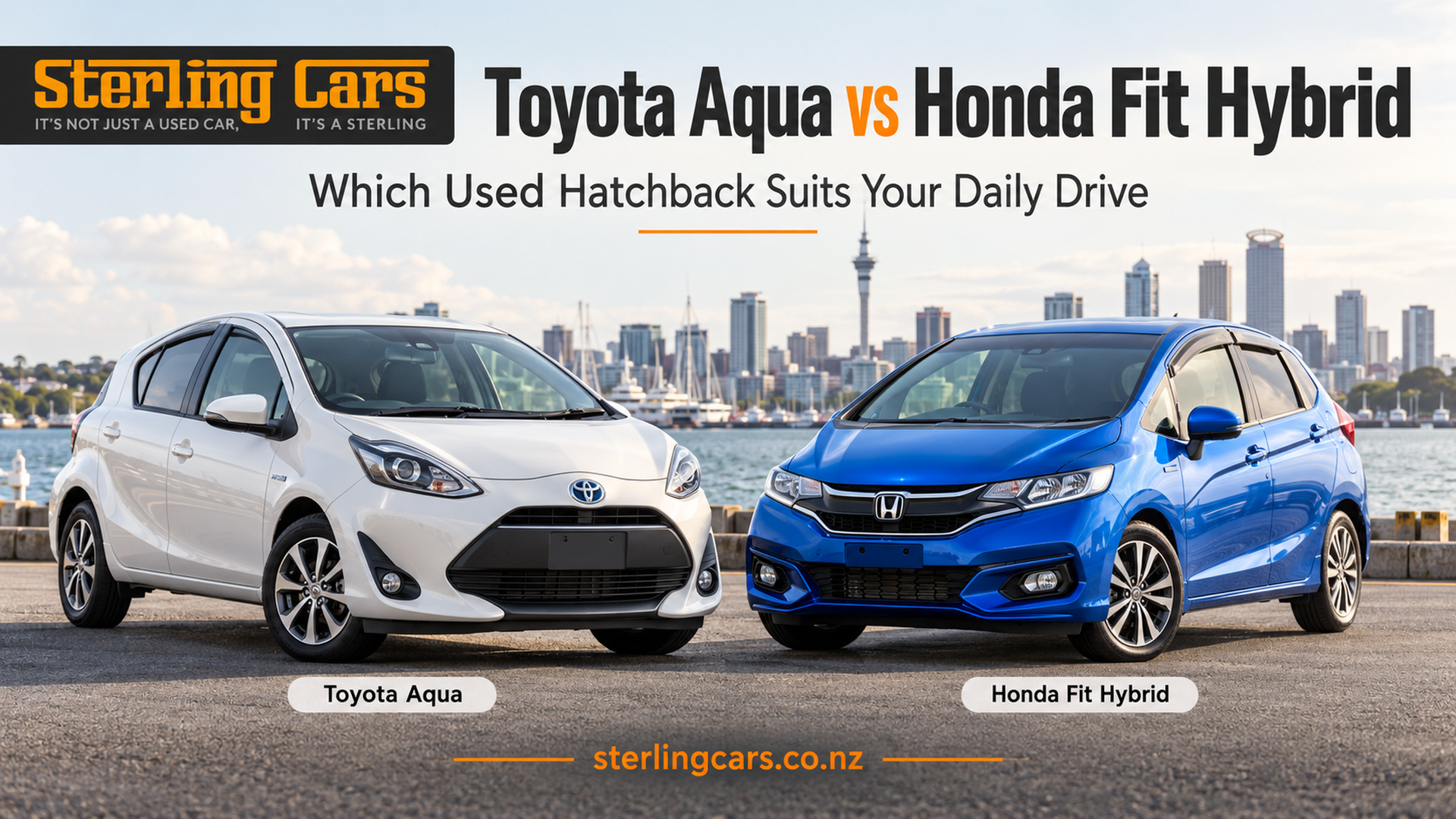
A small hybrid can make everyday travel feel straightforward. It fits into a busy working week, handles the supermarket trip and takes up a sensible amount of space when you get home.
The Toyota Aqua and Honda Fit Hybrid both belong on the shortlist for buyers looking for that kind of car. Each combines petrol-electric technology with compact hatchback practicality, but they offer different cabin layouts and driving experiences.
Choosing between them starts with your routine. Who travels with you? What do you carry? How much time do you spend in traffic, and what makes you comfortable behind the wheel?
At Sterling Cars, our Auckland dealership gives buyers a place to explore both models. Our [Toyota Aqua] and [Honda Fit] pages are useful starting points for checking availability and arranging a viewing.
Start With the Generation, Then Explore the Car
Before comparing two listings, establish exactly which versions you are viewing.
Toyota launched the first Aqua in December 2011 and introduced its second generation in July 2021. The Honda Fit Hybrid has used several different hybrid systems: the earlier IMA arrangement, the Sport Hybrid i-DCD system introduced with the 2013 redesign, and the later e:HEV system introduced with the 2020 generation.
This matters because “Fit Hybrid” does not describe one engine-and-transmission combination across every year. Equally, equipment and cabin details vary between Aqua generations and grades.
Confirm the model code, build information, drivetrain and specification. Cars advertised with the same registration year may still require a closer look to establish which version they are.
Toyota Aqua: A Compact Hybrid to Explore for Everyday Travel
The Aqua was developed as a dedicated compact hybrid. The original model uses a 1.5-litre petrol engine with Toyota’s Hybrid System II, combining engine and electric-motor power according to driving conditions.
For buyers, the attraction is easy to understand: a manageable hatchback with hybrid technology and a familiar petrol-refueling routine.
During a viewing, spend time finding your driving position. Check the seat adjustment, steering-wheel reach and visibility around the car. Try the dashboard controls and see whether the layout feels comfortable to use.
Then think beyond the commute. Open the boot, sit in the rear and check how the available space works for your passengers and belongings. An Aqua that suits one person’s working week may also need to accommodate weekend luggage or occasional family travel.
The right example should feel practical across those different uses.
Honda Fit Hybrid: Explore the Cabin’s Flexibility
Interior packaging is an important part of the Fit’s design. Honda’s 2013 launch information highlights its center-mounted fuel-tank layout and the resulting use of cabin space.
If your routine involves changing combinations of passengers and luggage, take time to examine the seating arrangement in the specific Fit you are viewing.
Ask the team to demonstrate how the rear seats operate. Check the floor, load opening and space available with the seats in different positions. Confirm the arrangement yourself rather than assuming every generation has identical functions.
The cabin deserves the same attention. Sit in the front and rear, assess headroom and check whether the seating position suits your regular passengers.
A practical interior is something you can establish during a viewing. Bring the items you carry most often and see how they fit.
How Do They Feel on the Road?
Both models use petrol-electric power, but the experience depends on the generation and drivetrain.
For example, the 2013-generation Fit Hybrid introduced a dual-clutch hybrid system. That is a different arrangement from the original Aqua’s Toyota hybrid transaxle, so it is worth becoming familiar with each car’s responses.
Drive on a route that reflects your week. Include slower streets, a hill and a motorway section where practical.
Pay attention to:
– Accelerator response when moving away.
– Ease of controlling speed in traffic.
– Braking feel and smoothness.
– Seat support and driving visibility.
– Road noise and ride comfort.
– Parking and reversing.
Ask the salesperson to explain the available modes and normal hybrid operation. If something feels unfamiliar, discuss it before deciding whether it suits you.
Neither a specification sheet nor another driver’s preference can tell you which seating position or driving response you will enjoy most.
Compare Fuel Use Carefully
Fuel economy is an understandable priority when buying a hybrid. However, figures from different listings may have been measured under different test standards.
Avoid comparing a Japanese laboratory figure for one vehicle with a different economy rating for another. Check the source, test cycle and exact variant.
Your own result will also depend on trip length, traffic, terrain, weather, tyre condition and driving habits. Short journeys and longer motorway trips place different demands on a vehicle.
Use fuel information to help plan ownership, alongside an inspection and a realistic view of how you drive. A small difference in an advertised figure should be considered together with condition, servicing and everyday suitability.
Features and Safety Depend on the Individual Vehicle
A model name does not confirm the equipment fitted.
When looking at an Aqua or Fit Hybrid, ask about the features on that exact car. Reversing cameras, cruise control, keyless entry, airbags and driver-assistance equipment can vary with year, grade and optional packages.
Have relevant functions demonstrated. Connect your phone, check the display language and establish whether the navigation and audio equipment meet your needs in New Zealand.
Check the current safety information for the specific vehicle through Rightcar. NZTA recommends reviewing a vehicle’s safety rating before buying.
Request available service records and ask what maintenance is due next. Find out what hybrid-system testing has been completed and whether there is a written report.
For the Fit, confirm the transmission type and its maintenance requirements for that generation. For either model, have unusual noises, vibration, warning lights or inconsistent operation assessed by a qualified technician.
A current Warrant of Fitness is important, but it is not a substitute for a pre-purchase inspection. NZTA explains that a WoF does not cover every aspect of mechanical condition.
Obtain an insurance quote for the exact vehicle, including its security equipment. Budget for servicing, tyres and maintenance as well as fuel. If optional mechanical breakdown cover is offered, check the policy’s treatment of hybrid components.
A Practical Way to Make Your Decision
Use your viewing to answer the same questions for both vehicles:
| Daily comfort | Seat support, driving position, ventilation and road noise |
| Passenger space | Rear-seat comfort with the front seats correctly adjusted |
| Luggage | Your usual bags or equipment, boot access and seating flexibility |
| City driving | Visibility, parking, maneuvering and low-speed response |
| Ownership | Service records, inspection results, insurance and upcoming maintenance |
| Equipment | The features fitted and whether they work as expected |
This keeps the decision grounded in the cars available to you. Their individual condition and specification deserve as much attention as their model names.
Find Your Everyday Hybrid With Sterling Cars
Your next hatchback should make the journeys you already take more comfortable and convenient.
At Sterling Cars, tell our team what your week looks like, the space you need and your preferred budget. We can discuss current Aqua and Fit Hybrid availability and arrange a closer look at suitable vehicles.
For customers outside Auckland, Sterling Cars also offers video viewings and nationwide delivery. Confirm the viewing arrangements and request a delivery quote for your location.
Explore both models with an open mind, review the details and take time behind the wheel. The best choice is the individual car that fits your life and gives you confidence in its condition.
Contact Sterling Cars to enquire about a Toyota Aqua or Honda Fit Hybrid.
Phone: 0800 771 881
Email: info@sterlingcars.co.nz
Frequently Asked Questions
Do the Toyota Aqua and Honda Fit Hybrid need plug-in charging?
No. The conventional hybrid versions discussed here manage charging through their onboard systems and regenerative braking. They still require petrol.
Do all Honda Fit Hybrids use the same transmission?
No. The Fit Hybrid has used different systems across generations. Confirm the drivetrain and servicing requirements of the exact vehicle.
How should I compare their interior space?
Adjust the driver’s seat, sit in the rear and test the luggage area with items you regularly carry. Ask for a demonstration of the seating functions.
Which model will use less fuel on my commute?
That depends on the specific versions, their condition and your route. Compare figures measured under the same standard and treat them as a guide rather than a guaranteed result.
Can Sterling Cars help me view both models?
Contact the team about current availability and viewing options. If you are outside Auckland, ask about a video viewing and nationwide delivery.